Labels

00 flour 7-spice 8-ball squash açaí acorn squash afternoon tea agar ale alfalfa allspice almond butter almond essence almond meal almonds alphabet amaranth amchoor american anise seed apple apple cheese apple juice apple sauce apricots artichoke asiers asparagus aubergine australian autumn avocado balls balsamic vinegar banana banana skin bannock barberries barley basil bath bomb batter bay BBQ sauce bean burger bean pasta beans beansprouts beauty beer beeswax beet greens beetroot belize beluga lentils berbere berry bicarbonate of soda birch syrup birthday biscuits black beans black eyed beans black garlic black pepper black trumpet blackberry blewit blue cheese blueberry bok choi borlotti beans borscht boston bran brandy brazil nut brazilian bread bread flour breadcrumbs breadsticks breakfast brezeln british broad beans broccoli broccolini brown lentils brown rice brown sugar brownies brussels sprouts bubble bubble mixture bubbles buckwheat bulghur wheat buns butter buttermilk butternut squash cabbage cacao cajun spice cake camping canada candied peel candles cannelini beans capers caramel caraway cardamom caribbean carob molasses carrot greens carrots cashew cauliflower cayenne celeriac celery celery seed ceps cereal champagne chanterelle chard cheese cheese rind cherry chervil Chestnut chia chia seeds chicken of the woods chickpea chickpea flour chickpea miso chickpeas child-friendly chilli chips chives chocolate christmas chutney cider cider vinegar cinnamon citric acid clapshot cloves coarse salt cocoa coconut coconut kefir coconut milk coconut oil coconut sugar coconut vinegar coffee collard greens compote cookies copenhagen cordial coriander coriander seed cornbread cornflour cornmeal cornstarch cottage cheese courgette courgette flowers couscous crabapple crackers cranberries cranberry cranberry sauce cream cream cheese cream of tartar creme de cassis crumble cucumber cumin cupuaçu curd currants curry curry leaves curry paste custard dal dandelion-ramp miso danish date date molasses dehydrator demerara sugar digestive biscuits dill dinosaur dip donuts dosa dragonfish dressing dried fruit drink dry tofu dukkah dulce de leche easter edamame egg egg yolk elderberry elderflower elephant english epsom salts essential oil evaporated milk fake milk fennel fennel seed fenugreek feta fiddleheads fig filo fire cooking firm tofu flan flapjack flatbread flour flowers focaccia fondant food colouring football freekeh fresh yeast frittata fritters galangal galette garam masala garlic garlic scapes gazpacho german gin ginger ginger wine gingerbread glass noodles gluten-free glutinous rice flour gnocchi goat's cheese golden beets golden raisins golden syrup gooseberry gorgonzola graham flour granola grape grape molasses grapefruit greek green beans green pepper green plantain green tea green tomato haggis haricot beans harissa hazelnut hedgehog mushroom hemp seeds holy basil hominy honey horseradish hot cross buns hummus ice lollies iceland icing icing sugar indian injera irish italy jackfruit jam jamaican japanese jelly jicama kahlua kale kale chips kalonji kefir ketchup kohlrabi koji kombucha lasagne latkes lavender lebkuchen leek leek flowers lemon lemongrass lentils lettuce lime lime leaves linseed lion's mane mushroom liquorice powder lovage lunch macadamia nuts mace mahlab maitake mango maple syrup marble marigold marmalade marzipan masa harina mascarpone mash melon membrillo mexican milk millet mince pies mincemeat mint mirin miso mixed spice mochi moghrabieh molasses morel mousse mozzarella muesli muffins mulberry mulberry molasses mung beans mushroom mushroom powder mushroom stock mustard mustard oil naan nachos nasturtium new york no-bake cake noodles not food nut butter nut roast nutella nutmeg nutritional yeast oat yoghurt oatmeal oats okara okra olive oil olives onion onion skins onions orange orange blossom orange juice oregano oyster mushroom package pancakes panch phoran papaya papaya seeds paprika parkin parmesan parsley parsnips pasta pastry peach peanut peanut butter pear peas pecan pecan pie pecorino pepper pesto petersilienwurzel philadelphia physalis pickle picnic pie pine nuts pineapple pistachio pizza plantain plum polenta pomegranate pomegranate molasses ponzu popcorn poppy seeds porridge potato potluck preserve pretzels prune psyllium seed husk pudding pumpkin pumpkin seed butter pumpkin seeds purple carrots purple noodles purple potato puy lentils pyo quince quinoa radicchio radish radish greens rainbow cake raisins raita ramps ras el hanout raspberry ratatouille ravioli red cabbage red kidney beans red lentils red onion red wine red wine vinegar redcurrant jelly redcurrants relish restaurant reykjavik rhubarb rice rice flour rice pudding rice vinegar ricotta risotto rocket rolls root veg chips rose rose harissa rosemary rugbrød rum runner beans rye saffron sage sake salad salsa salsify salt sauce sauerkraut scones scottish sea buckthorn seaweed seeds semolina sesame oil sesame seeds sesame tofu seville orange shepherd's pie shiso silken tofu skyr slaw sloe snacks snow soba noodles socca soda bread sodium hydroxide soup sour cherries sour cream south american soy sauce soybean spaghetti spaghetti squash spätzle spelt spelt berries spinach spread spring spring onion sprouts squash st. george's mushroom star anise stew stout strawberry strawberry powder sugar sultana sumac summer sunchoke sundried tomato sunflower seed butter sunflower seeds super firm tofu sweet sweet potato sweetcorn tacos tahini tamale tamari tamarind tapioca flour tarragon tart tea tealoaf teff tempeh thai thyme tiers tinned peaches tkemali toast tofu tofu scramble tomatillo tomato tomato puree tonka bean toronto tortilla chips tortillas tray bake treacle truck truffle turmeric turnip turnip greens tyttebær udon umeboshi vanilla vanilla bean vegetable stock veggie burger vermouth vine leaves vinegar walnut oil walnuts wasabi watermelon watermelon radish wax wheat berries whisky white balsamic vinegar white beans white chocolate white pepper white spelt flour white wine wholemeal wild garlic winter wood ear xanthan gum yeast yellow beans yellow split peas yoghurt za'atar zimtsterne
Showing posts with label orange. Show all posts

Sunday, December 28, 2025

Mandarin and hazelnut cake

For my birthday, S wanted to make me a cake. He asked for a suggestion. I asked my friend H, who is an excellent baker and shares many food interests with me. Specifically, I asked her for something easy, delicious, and that I had not tried before.
 
She suggested this one, S made it, and it ticked all the boxes. Not only that, it also felt very seasonal, with the oranges and hazelnuts - and was easy to transport, and kept well! And was perfect for a morning cake when I took a bit to work for work birthday celebration on the next workday after my birthday, which was a bit of a ghost ship day and I wanted to leave before lunch - I took some skyr to go with it and it had a lovely Christmas-brunch vibe for the few people I scraped together.
 
I would definitely make this again. I'd be tempted to try some variations as well - H suggested using ground almonds instead of hazelnuts; we have plenty of walnuts; how about swapping out the ginger for cardamom (inspired by this)? Lemons instead of oranges?

Note: S says he used cup measurements for everything except the hazelnuts - but then he would have been using US cups (240 ml = 1 cup) instead of AU cups (250 ml = 1 cup). So his version may have been slightly unique.

For the cake:
3 organic mandarins (about 95 g each), washed, unpeeled
4 eggs
270 g sugar (1 1/4 AU cups)
90 g melted butter
400 g hazelnut meal (ground hazelnuts)
75 g plain flour (1/2 AU cup)
2 tsp finely grated ginger
⅓ tsp baking powder
pinch of salt 

For the syrup:
220 g sugar (1 AU cup)
125 ml mandarin juice (1/2 AU cup)
1 tbsp julienne ginger
4 mandarins, peeled and thickly sliced crossways
Juice of ½ lemon

Heat oven to 160C and butter and flour a 12cm x 20cm loaf tin (he used our standard sized loaf tin). Place mandarins in a saucepan, cover with plenty of water, bring to the boil and cook until soft (20-25 min). 
 
Drain, cool and chop (discard seeds), then purée in a blender or food processor.
 
Whisk eggs and sugar until pale and fluffy (3-4 min in an electric mixer, which would be ideal if we had one). Fold in mandarin purée and butter, then fold in hazelnut meal, flour, ginger, baking powder and a pinch of salt. Spoon into prepared tin, smooth top and bake until golden brown and a skewer inserted withdraws clean (1-1¼ hours). Turn out onto a wire rack to cool.
 
For mandarin and ginger syrup, combine sugar, mandarin juice and 125 ml water in a saucepan over medium-high heat and bring to the boil, stirring to dissolve sugar, then add the ginger and simmer until translucent and a light syrup forms (6-8 min). Stir in mandarin slices and lemon juice, remove from heat and leave to cool.
 
Serve cake with mandarin and ginger syrup spooned on top. We did this per slice, and I think this was good, as the cake could have gone a bit soggy when stored if you did the whole thing at once - also this way you could have as much or as little syrup as you wanted, and try it without the syrup (almost as good!). I also really liked it with some skyr or greek yoghurt.
 
Cake will keep stored in an airtight container for 3 days - or longer in the fridge. Store the syrup separately.

Monday, December 22, 2014

Mulled wine / goodbye Boston

The clock is ticking through our final week in Boston. Doesn't quite seem real... Yesterday we had a birthday / christmas / solstice / goodbye / freeloading party - I guess things started to feel more real... Lots of friends came by to say goodbye and help us out by taking some of our stuff away (I was taken aback by the attendance, given the time of year). Seb rolled out his pretzel factory for one last time in Boston, and I kept a pan of mulled wine going on the hob all afternoon / evening.

The mulled wine is made the same way I used to make it as an undergrad, and ever since - lots of Christmassy memories. I am in the less-is-more camp when it comes to alcohol levels: I like to add orange juice rather than spirits. The orange juice provides sufficient sweetness for me, but in you like it sweeter you can add honey or have it nearby so people can add some to suit themselves.

I can't imagine there'll be much more cooking this Christmas - everything is in boxes and we have hardly any food left. So I suppose this is it.

(makes ~20 servings)

~ 2 bottles red wine (not the cheapest, but not the best either)
1.5 litres fresh orange juice
1 medium-large orange, sliced
2 cinnamon sticks
8-10 cloves
~5 whole green cardamom pods (optional; allspice / nutmeg might also be good)
honey on the side

Pour the wine into a large saucepan and add the orange juice. Add a bit at a time and taste in between until you get a wine-juice balance you like. Add the sliced orange, cinnamon sticks, cloves and cardamom to the pan and heat over a low heat until it is just below a simmer. Keep the heat really low, so the mulled wine stays warm but does not boil. Ideally keep like this for ~30 min before ladling out the first serving. You can keep it going (below boiling) a few hours, and you can top up the liquid a couple of times before the spices lose their power.

Monday, October 27, 2014

Chocolate, ginger and orange biscuits with golden syrup

S discovered a new word while surfing Urban Dictionary the other day: procrasturbaking (meaning, baking as a form of procrastination). Yesterday I was a little short of sleep / hungover after aerial show and subsequent drinks, and just really didn't feel like working (it was Sunday!). So I read some Guardian online instead, and found this biscuit recipe. And then I procrasturbaked.

The recipe was easily veganisable, which tempted me. And I love golden syrup. Also it's another good opportunity to use stuff up - this time weird hot chocolate in the form of dusty chocolate chunks, and homemade crystallised ginger and candied peel.

(makes approx. 20 biscuits)

50 g golden syrup
150 g light brown soft sugar (I used a mixture of this and raw sugar and it was fine)
90 ml sunflower oil
1 tsp vanilla essence
60 ml fake milk
210 g plain flour
¼ tsp bicarbonate of soda
¼ tsp salt
100 g candied ginger (used a mixture of candied ginger and candied peel)
100 g dark chocolate, chopped into small chunks
Zest of 1 orange (added candied peel to the ginger instead)

Heat the oven to 180C / 350F and line two baking trays with baking paper.

Measure the golden syrup, sugar, oil, vanilla essence and fake milk into a large bowl and mix. In a separate bowl mix the flour with the bicarb and salt, then add this to the wet ingredients. Stir until the just combined, then add the candied ginger, chocolate and orange zest (or candied peel).

Put teaspoons of the batter on the prepared baking trays, leaving space for spreading. Bake for 15-17 min, until the cookies’ edges are golden brown and the centres are puffy. Leave to cool for ~10 min then transfer to a wire rack to finish cooling.


I had to put one tray in the bottom of the oven, which it turns out is really hot. So those ones were a little burned. The rest were excellent though - nice texture, and the ginger / orange / chocolate combination is definitely a good one. Clever idea to use syrup to make a chewy texture. I think these would be easily made gluten-free as well (I'd sub plain flour with an almond-rice-cornflour mix similar to this) - the golden syrup may help with binding.

Friday, April 4, 2014

Beetroot and orange salad

A said she found beetroot inspiration (beetspiration?) on here the other day, which in turn inspired me to make something with the candycane beetroots festering in my fridge.

Of course they keep pretty much forever so no rush (same with the oranges), but I've been on a bit of a using-up kick so it felt good to eat them up.

I have been down on candycane beetroot of late - you just cannot cook them as they lose their pattern and colour and their flavour isn't as intense as the fully-pink ones either. But if you keep them raw they are lovely, so if you have candycane (Chioggia) beetroot this salad is the right sort of thing to do.

juice and zest of 1 orange (ended up with zest of normal orange and juice of Seville orange)
1/4 clove garlic, crushed with salt
1 tsp pomegranate molasses (or honey - if using honey and normal orange juice add a squeeze of lemon as well)
1 tsp white miso
2 tbsp olive oil
4 small beetroot (mine were candycane and very pretty but normal would be fine too), peeled and cut into matchsticks
2 medium carrots, peeled and cut into matchsticks
1 tbsp sesame seeds, toasted
handful of chopped coriander
Put the orange juice and zest in a small bowl and mix in the crushed garlic. Add pomegranate molasses, miso and olive oil and whisk together to make the dressing. Set aside. 

Prepare the beetroot and carrot and put the matchsticks in a serving bowl. Add the sesame seeds and coriander, then tip the dressing in and mix well. Good immediately or after being in the fridge overnight (perhaps keep the sesame seeds and coriander separately if overnight is the plan).


This was nice. The Seville oranges contain masses of juice so it ended up quite juicy and sharp - think this would be softened if normal orange was used, probably no bad thing. Very pretty - striped beetroot, orange, green and seeds; just enough crunch.

Monday, January 27, 2014

Orange, almond, cardamom, honey and polenta cake (gluten free)

It's my cake baking time of year again - both my lab cake making duty (for N, who is leaving this week, so probably the last time I will make one for him), and then S's birthday in a few weeks. Winter birthdays have their disadvantages but the enjoyment of time spent indoors baking on cold days is not one of them! N suggested nuts or fruit, so I decided to use both and make this.

This is a cake I haven't made for ages. My sister T used to make it, and I used to love it. I begged her for the recipe years ago, promptly lost, misplaced or forgot it. It took me a while to track down the source on the internet, but I am pretty sure I found it - Nigel Slater, here. I considered not adapting it, but couldn't help myself (/ had no butter and eggs in the house), so here is a veganised version. It is actually also gluten free.

For the cake:
220g refined coconut oil (or margarine)
220g sugar (for prettiness try and get golden caster)
100g slivered almonds (for prettiness use ones without skin)
200g ground almonds (for prettiness try and get blanched ones)
3 tbsp ground linseed mixed with 9 tbsp boiling water (for prettiness use golden flax)
150g polenta (optional for vegan version - add 1/4 tsp xanthan gum and 1/4 tsp turmeric to the polenta)
1 level tsp baking powder
finely grated zest and juice of a large orange
12 green cardamom pods

For the syrup:
Juice of 2 lemons
juice of 2 oranges
4 tbsp honey

For decoration:
1 whole orange, peeled neatly with a sharp knife and then sliced thinly

Line the base of the cake tin with a piece of baking parchment. Set the oven at 180C/360F.

Beat the coconut oil and sugar together til light and fluffy. Grind the slivered almonds in a blender til finely chopped, then add them, together with the ground almonds, to the cake mixture. Stir in the linseed-water mixture. Mix the polenta and baking powder, then fold into the cake mix, together with the grated orange zest and juice. Extract the black cardamom seeds (discard the green outer shells), grind them to a fine powder, then add to the cake mixture.

Transfer the cake mixture to the lined tin and smooth the top level. Bake for 30 minutes, turn down the heat to 160C/320F for a further 25 -30 minutes or until the cake is firm.

To make the syrup, squeeze the lemon and orange juice into a small saucepan, bring to the boil and dissolve in the honey. Keep the liquid boiling until it has formed a thin syrup (4-5 min). Spike holes into the top of the cake (still warm and in its tin) with a skewer (or thin knitting needle) then spoon over the hot citrus syrup.

Leave to almost cool, then lift out of the tin*. I decorated by arranging thinly sliced orange (1 whole large orange sliced into cross sections as neat and thin as I could manage with a sharp knife) on top.


*this was fairly unsuccessful - I had to leave paper and tin base stuck on for decorating and serving


This comes out dense and sticky and delicious. I suspect a little fat came out the base and burned on the bottom of the oven - prob a good idea to put it on a baking tray. Perhaps the cake could use a touch less coconut oil - could help with the sticking of the base as well as any leakage. Lining the sides and base with a continuous sheet of paper (or base+long strips) should also help with both sticking and leakage.

Sprout, watermelon radish and orange salad

An unusually bright, crisp and cheerful winter salad, inspired by the contents of the CSA.

1 punnet mixed salad sprouts
1 medium watermelon radish, peeled, quartered lengthwise and thinly sliced
1 large orange, pith and peel removed from the outside
1 tbsp white miso
1-2 tsp marmalade
1 tbsp red wine vinegar
1-2 tbsp olive oil
salt+pepper

Put sprouts in a salad bowl. Slice the radish (it's so pretty!) and add to the bowl. Cut off as much peel and pith from the outside of the orange as you can, then cut out the segments, leaving behind the separating membranes. Add the orange segments to the bowl. Squeeze the juice out of the remaining orange into a small bowl, then add the remaining ingredients and whisk with a fork. Add the dressing to the bowl and toss. Eat right away.

Monday, December 2, 2013

Apple and fresh cranberry chutney

I remembered fresh cranberries are in season, bought a bag, and commenced experiments. Raw they are very sharp - they need some kind of sweetness or dilution. I baked: cranberry and apple crumble, cranberry and pumpkin muffins. Wanted to go somewhere savoury with the rest of the bag. Considered some ideas from the Cranberry Slam at Egleston Farmers' Market. The most interesting was somewhat complicated, with several steps including fermentation. I decided to borrow some of the flavours but just make a chutney - that way my savoury cranberry stuff would keep for a while, into times when fresh cranberries are nowhere to be found. I based it on this recipe, tweaking the spices and flavour additions.

(made 2 small jars - sensible to scale up if you have a full bag of cranberries!)

450 g apples (~ 2 large ones), peeled and chopped into chunks
135 g onions (~2 small ones), peeled and chopped or sliced
1 small clove garlic, peeled and finely chopped
~2 cm piece root ginger, peeled and finely chopped
zest of 1 little orange
1/4 tsp caraway seed
1/4 tsp cumin seed
1/4 tsp coriander seed
1/4 tsp mustard seed
1/4 tsp chilli flakes
75 ml cider vinegar
150 g sugar
150 g fresh cranberries
 
 Put all ingredients except the cranberries in a saucepan and bring to the boil. Simmer for ~50 min, until everything is reduced, thickened and broken down. Add the cranberries and cook for ~10 min more - try not to let them all burst. Spoon into sterilised jars, seal while hot and then let cool before labelling. Tastes best if allowed to mature for ~1 month before opening.


This looks very pretty and festive, with seeds, strands of orange zest and ruby cranberries pressed up against the glass. Haven't tasted the mature version yet but am hoping it is not too sweet.

Edit: well, it is a bit sweet (although very pink-red and pretty). The explosions of whole cranberries are really delicious, same with the spice seeds, but the background is mainly like applesauce and just a bit too sweet. Cooking apples instead of eating apples would probably be a good idea, if possible. But anyway, this did go very well with nut loaf for Christmas.

Pumpkin, cranberry, chocolate and orange muffins

I had experiments with a bag of fresh cranberries in mind - first crumble (with apples I scrumped with M the other day), then these. I based them on a pumpkin muffin recipe I'd used before, but tweaked the flavours to incorporate the chocolate, ginger and orange I wanted to be in there. It's kind of a second iteration of these ones.

(Makes 12)

1 3/4 cups plain flour
1 tbsp baking powder
1 cup granulated sugar
1/4 cup demerera sugar
1 1/2 tsp ground ginger
Pinch of salt
Zest of two little oranges
1/4 cup chopped dark chocolate
1 cup pumpkin puree
1/2 cup fake milk
1/2 cup veg oil
1 cup fresh cranberries, roughly chopped

Heat oven to 400F. Prepare a muffin tin. Mix flour, baking powder, sugars, ginger and salt in a bowl with a fork. Add orange zest and chopped chocolate and mix again. In a separate bowl beat together pumpkin puree, fake milk and oil. Add wet to dry and mix til just combined, adding the chopped cranberries in the last few strokes. Scoop the mixture into muffin cups. Bake for ~25 min, until golden brown and a skewer comes out clean. Let cool for a few minutes in the tin before transferring to a cooling rack.


These are great. I overcooked them slightly but the pumpkin makes them wonderfully orange in colour, the orange and ginger taste exciting, and the cranberries and chocolate are beautiful to see and insert little jewels of intensity... Yum.

Monday, July 1, 2013

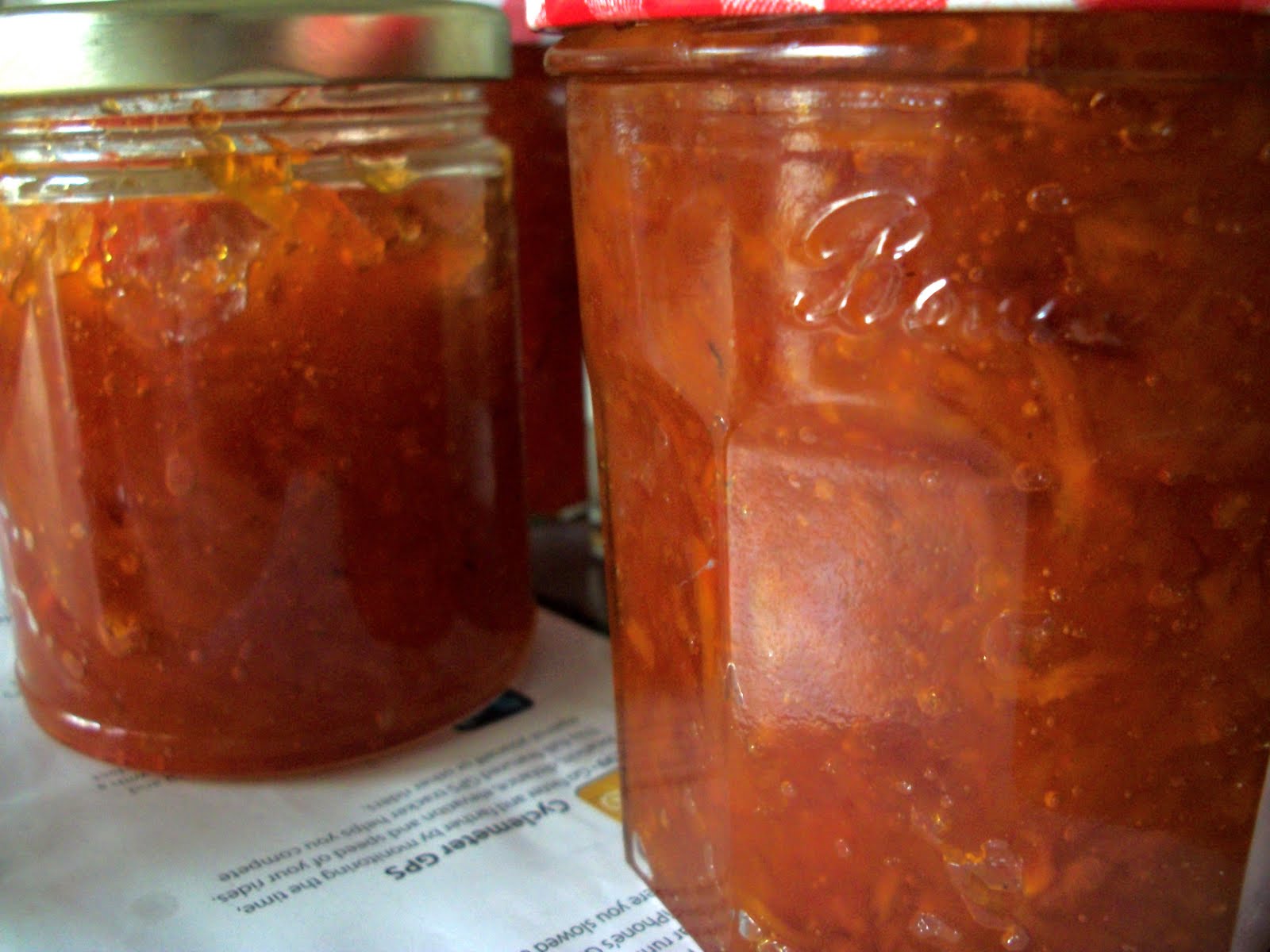
Mulberry harvest: mulberry and orange jam

I kind of thought I had taken more berries: was thinking of trying dehydrating too. After looking at so many all day my sense of scale was completely screwed. Anyway, I ended up with about 3 lb that needed using quickly - I strapped them to the back of my bike and they dripped a trail of black juice that looked like engine oil through three plastic bags and a (broken) plastic tub. Mulberries seem to be low pectin, so I decided to include orange in the hope of improving the set (and because I thought it might taste interesting). I was a little nervous about getting good results as I knew I needed to return some jam to LUrC.

(makes ~ 3 medium jars)

3 lb mulberries
1 orange
2.6 lb sugar

Wash mulberries (don't bother removing the little stems) and put them in a large pan. Try and include some of the somewhat underripe ones (red / white / greenish) as these will help with set (mulberries are low in pectin). Add the juice and grated zest of the orange. Bring to the boil and simmer for 30-60 min, until the berries are quite well broken down and the volume is reduced. Add the sugar and boil fast until setting point is reached (30-60 min). Let cool for ~10 min, then transfer to sterilised jars and leave to cool.


Hmm, I slightly overboiled it because of my nerves and it ended up crystallising slightly. Bums. This has only happened to me once before. I am embarrassed.

Monday, March 25, 2013

Carrot, orange, sumac and olive rolls

I hadn't made any bread in a while, not sure why, it's been Winter and a good time for hanging out in the kitchen and baking. Anyway, I saw this recipe (with additional fancying-up here), and thought it was time to make bread. I decided to go for the rolls with olive and sumac.

175g carrot
150ml warm water
100ml orange juice, at room temperature
7g sachet fast-action yeast (used 2 tsp)
25ml olive oil, plus more for kneading
450g strong white flour
50g wholemeal or spelt flour
2 tsp salt
250g dry pitted black olives, roughly chopped (if making rolls)
2 tsp sumac (if making rolls)
50g black or white sesame seeds, plus extra to finish

Peel and grate your carrots and put them in a mixing bowl. Add the warm water and orange juice.

Stir in the yeast, leave 5 min til dissolved, then add the oil, flours, salt and seeds (also sumac and olives if making rolls) and mix well to a firm-ish dough. You can add slightly more flour or water according to your preference, but use the amounts here as a starting point. Leave the dough covered for 10 minutes.

Gently knead the dough for 10 sec or so, then leave in the bowl, covered, for about an hour / until risen by half.

To make a loaf: Take a large loaf tin and line the base and sides with nonstick baking paper. Dust a surface with flour, then pat the dough into an oblong. Roll the dough tightly like a scroll, squeeze the ends together as you pick it up and lower it, seam-side down, into the tin. Cover and leave for about an hour. Heat oven to 200C//400F. Lightly wet the top of the dough, then sprinkle it thickly with sesame seeds. Cut a deep slash down the middle and bake for about 50 minutes. Remove the loaf from the tin and leave to cool on a wire rack.

Or, to make rolls: divide into a dozen 100g pieces for large rolls (or 75g for 16 medium-sized ones), shape into balls with a little flour and leave to rise on a baking tray lined with non-stick baking paper. Leave to rise for about an hour, or until risen by at least half. Heat oven to 180C/350F. Before baking, brush the top of each roll with water and sprinkle on sesame seeds. Using a pair of scissors, or a small serrated knife, snip or slash the top of each roll. Bake for about 25 minutes for soft rolls, or up to 35 minutes for crustier ones. They freeze well and can be reheated direct from frozen in a hot oven.


I liked these, but they didn't rise very well (time for new yeast?), and I found the olive taste overpowering - perhaps next time stick to the version without olives?

Sunday, March 10, 2013

Hamantaschen (vegan and gluten-free)

L-R: normal dough with prune-poppyseed filling, GF dough with apricot-almond filling, GF dough with spiced fig-cocoa filling
Before I came to the US I knew little about Jewish culture. Then we moved into a historically Jewish neighbourhood (our nearest shops are a Jewish bakery and a Jewish butchery; most of the businesses around here close on Saturdays). And I discovered that really quite many of the people I'd befriended here are Jewish. However much they do or don't practice the rest of the year, they've done a good job of educating me about important festivals (and the food involved). My friend A in particular (my partner in baking for awesome cakes) has invited us for her version of Passover and Rosh Hashanah celebrations every year, and also fed me my first Hamantaschen.

Ever since I tried Hamantaschen I wanted to make them, and to make them vegan (and GF so my friends A+H can eat them). They are basically a free-standing jam tart, folded into a triangular shape, with some sort of fruity or seedy filling in the middle. They are traditionally eaten for Purim.  Loosely, Purim: is 'like the Jewish Halloween' ie people get dressed up; you're supposed to get so drunk you forget the difference between good and evil (or something like that); Haman is a villain involved somewhere; Hamantaschen are supposed to represent Haman's hat (?). Purim is always around this time of year, although it varies and this year it was actually late February, when I was very much distracted by Pancake Day and S's birthday, so I didn't get around to Hamantaschen until I was reminded by this post - it seemed like exactly the recipe I had been dreaming of. I decided to follow the recipe to ensure success for some, and make a series of deviations for others.

Normal dough
(makes 20-25 - taken from this recipe)
1/3 cup coconut oil (solid state)
1/2 cup sugar
1/2 cup almond milk
1/2 tsp lemon zest
2 tsp vanilla essence
1 7/8 cups flour
1 tbsp cornstarch
1/2 tsp baking powder
1/2 tsp salt

Gluten-free dough
(makes 20-25)
1/3 cup coconut oil (solid state)
1/2 cup sugar
1/2 cup almond milk
1 3/4 tsp vanilla essence
1/8 tsp almond essence
1/2 cup almond meal
3/4 cup gluten-free oat flour
1/2 cup rice flour
1/4 cup glutinous rice flour
1 tbsp chickpea flour
3 tbsp cornstarch
1/2 tsp baking powder
1/2 tsp salt
1 tsp xanthan gum

Prune and poppyseed filling*:
4 oz dried prunes, chopped
1/8 cup poppyseeds
1/8 cup sugar
1 tbsp rum
1 tbsp orange juice
water

Apricot and almond filling*:
4 oz dried apricots, chopped
1/8 cup almonds, finely chopped
1/8 cup sugar
1 tbsp lemon juice
1 tbsp rum
water

Spiced fig and cocoa filling*:
(inspired by the delicious Fichi Girotti (stuffed fig sweetmeats) we ate in the town of Amelia in Italy)
4 oz dried figs, chopped
1/8 cup walnuts, finely chopped
1/8 cup sugar
1 tbsp cocoa powder
1/4 tsp ground cinnamon
1/4 tsp mahlab
2 tbsp candied orange peel
1/2 tsp orange zest
1/8 tsp almond essence
1 tbsp rum
water

* Each filling recipe given here makes enough to fill approx 1/3 of the total from the combined GF + normal dough quantities above. Other alternative fillings are any kind of jam, thick stewed fruit, nutella, anything you like really.

To make dough, beat the coconut oil and sugar together in a mixing bowl with a fork until well combined (will still be a bit crumbly). Warm the milk to about hand hot and add it to the bowl gradually, beating to incorporate. Add in the essence(s) and zest (if using). Separately, mix together the flour(s), cornstarch, baking powder and salt (and xanthan gum if using) with a fork. Add about half of the flour mix to the oil mix and beat until combined. Then add the rest of the flour and mix until a stiff dough is formed. It will still be a little soft. Wrap the ball(s) (make two if doing a double quantity of either dough) in clingfilm and put in the fridge for 30-60 min.

In the meantime, make the filling(s). Put the dried fruit in a small pan with the nuts or seeds, sugar and any dried spices. Measure the liquid ingredients into a measuring cup and make the quantity of liquid up to 1/4 cup by adding water, then add the liquid to the pan. Cover and simmer until the dried fruit are soft and squishy. Add more water if it seems to be getting too thick - it should end up like a thick jam.

Preheat the oven to 350F. Line two or more baking sheets with baking paper. Flour a clean surface, then take a ball of dough out of the fridge, remove clingfilm and roll out to about 3mm thick. Cut into circles about 3 inches diameter (I used a Coke glass). Put a tsp of filling in the centre of a dough circle, then fold up three sides to create a shape like a tricorn hat, pinching the corners together tightly. Repeat for all the circles, moving the completed tricorns to the baking sheet when done. Gather the excess dough and roll out again to make more circles and continue with the process until all the tricorns are filled. Bake the biscuits for 18-20 minutes, checking and rotating the sheets after 10 min. The bases will colour golden, but the tops will remain quite pale. Cool on a wire rack.


My favourites of all these variants were the GF dough with apricot filling - if you were going to make one kind of dough and one kind of filling that's what I would recommend. The GF dough held its shape much better than the normal one - I think mainly because it puffed up less. Half to two thirds of the normal dough ones came undone at the corners while cooking, and where I'd used a runnier filling especially they ended up as circular cookies covered in jam. In those cases, plenty of jam slid off onto the baking sheet and I was very glad I'd lined the sheets with paper - would have been a huge pain to clean otherwise.

All in all, I thought these were great (they took me a while to make, but that would be much reduced if you stuck to one kind of dough and one kind of filling). And all the ones I took to a seed swap this morning disappeared (a particular hit with one little girl), so they seemed to be a success. There's loads of scope for varying the recipe (even more than I did already) - was thinking a savoury version might make a great canape. I love the cleverness of the simple folding - you can make an open tart without needing any kind of a baking mold.

Saturday, February 23, 2013

Hedgehog cake (orange, carrot and pistachio cake with mocha-sunflower icing)

This is S's birthday cake. He mentioned carrot cake at some point, also mentioned cake in the shape of a hedgehog at some point, he likes nuts and coffee, and I'm still trying to find the perfect carrot-coffee-nut combination after he requested it a few years ago.

Cake recipe adapted from this one (my quantities are weird because I scaled it down to make two layers instead of three).

For the cake:
50g tahini
83ml sunflower oil
2 tbsp pomegranate molasses
zest of 2 oranges, and 67ml juice (juice of approx 1 orange)
150g soft light brown sugar
2 tbsp ground linseed mixed with 5 tbsp boiling water
133g carrot, grated finely
67g chopped pistachios
117g plain flour
1 2/3 tsp baking powder
1 1/3 tsp ground cinnamon
1 tsp ground cardamom
1/3 tsp grated nutmeg

For the icing:
(this made too much - half or two thirds this quantity would have been sufficient)
16 oz firm silken tofu, drained
1 tbsp veg oil
1 tbsp very strong coffee
1/2 cup icing sugar
1/4 cup cocoa powder
1/2 tsp ground cinnamon
1/8 tsp salt
2 tsp vanilla essence
1/2 cup smooth sunflower seed butter

To finish:
~1 cup slivered toasted almonds
3 raisins (1 big one for the nose and two smaller, equal-sized ones for the eyes)

Heat the oven to 360F / 180C. Grease two 8 inch round cake tins and line the bases. In a large bowl, whisk together tahini, pomegranate molasses, orange zest and brown sugar until smooth. Beat in linseed mixture, then stir in the grated carrot, pistachios and orange juice. In a separate bowl, mix the flour, baking powder and spices with a fork. Add the flour mixture to the wet mixture and fold together until just combined. Divide the mixture between the prepared tins and bake for 25-30 minutes, until a skewer comes out clean. Leave to cool in tins.

While the cake is baking, make the icing. Crumble the drained tofu into a blender jug, add the oil and coffee and blend until smooth. Add the icing sugar, cocoa, cinnamon, salt and vanilla and blend until smooth. Add the sunflower seed butter and blend until consistent. Transfer the icing into a bowl, cover and refrigerate for an hour, until thickened.

When the cakes are cool and the icing chilled, you can assemble the cake. For a normal cake, just layer it up and stop here.

I wanted to make a curved, bilaterally symmetrical hedgehog shape. I made 4 layers (plus a little bit more on top, using almost all of the two circular cakes. I took one of the circular base papers (cleaned of cake bits) and cut out a template for the bottom layer (approx egg shaped; long side length equal to diameter of circle), then cut this shape out of one of the cakes with a sharp knife (save the offcuts for the upper layers), cutting at an angle of ~45 degrees. I then trimmed about 1 cm around all the edges of the template and cut this shape out of the other cake (working at the edge). Stack them so you can see how it is looking. Trim another centimetre off the template and cut the shape out of a combination of offcuts. Repeat. Use remaining offcuts to create a rounded top. Hopefully the stacked shape will look OK, if not you can do some rearrangement / trimming.

Next, put the bottom layer on a plate. Cover it with icing then add the next layer, Repeat until all the layers are done, also using the icing to stick the pieces together where the layers comprise more than one piece. Once the pieces are all layered up, cover the outside with icing. Make sure to fill in all the cracks and to go right down to the plate; you can use the icing to correct minor irregularities in shape. Smooth it out when done. Starting about 1/4 of the way back from the pointed end, stick slivered almonds into the icing to make spines. Cover the entire back part of the cake with these. On the part without almonds, make striations with a fork to look a bit like fur. Finally, choose your raisins, squish them into shape, and press into position on the cake.


This looks really fun - the almonds and raisins are quite effective, as good as I might have hoped. The cake is delicious - bit of a faff with all the chopping and grating and zesting and juicing and so forth, but tasty enough to warrant it on a special occasion. They didn't rise much but they did hold together very well as I cut and layered them. Carrot cake should be dense anyway, so I don't think the lack of eggs mattered much.

The icing is very soft but does stay in position. I wondered if the seed (or nut) butter was a necessary addition or if it would have been just as good without. Same with the cocoa - I added it mainly for colour but it might have been brown enough without. It definitely doesn't taste of tofu at all. Does taste of sunflower butter though, and with that plus the cocoa once again I have managed to drown out the coffee flavour. Tastes fine in combination with the cake though: the flavours work together well. (note: I may have been eating the leftover icing out of the tub with a spoon like pudding, this was kind of good - it's fairly light)

Saturday, January 12, 2013

Earl Grey Marmalade and Dark Marmalade

Left: Dark marmalade; Right: Earl Grey marmalade
Realised it is marmalade orange season. It's such a short season, and they are hard to find - I guess not many people here are making marmalade. I don't know what else you can make with them - they are too bitter for most things. As soon as I realised it is time (season is basically January and that's it) I wanted to hunt for them.

We found them in Arax Market in Watertown today. So then I had to make marmalade. I had nearly 3 lb of oranges, so decided to try two variants. One (the dark marmalade) is direct from my AFRC Institute of Food Research 'Home Preservation of Fruits and Vegetables' book (first published in 1929; basically the preserving Bible; it's out of print but Grandma found me a copy when I first started jamming). The other (the tea marmalade) just occurred to me as I was assembling the ingredients: it seemed like it should work.

Below is the basic marmalade recipe. You can make it pure without additions for the traditional deal, or add either tea or molasses for my two variants.

Note: if you can't get hold of Seville oranges; lemons, limes and grapefruit (or some combination of citrus fruit) all make good marmalade - but don't use sweet oranges alone, they lack the sharpness you need.

(makes 4 jars)

600g Seville oranges (approx. 4 medium ones)
1/2 tsp citric acid (or add one lemon along with the oranges)
~1.3 litres water
1.2 kg sugar
for dark marmalade: 2-3 tsp molasses
for tea marmalade: 1 Earl Grey teabag (if doing again, use 2 or more teabags: the flavour was lost with only one)

Wash the oranges thoroughly. Chop into quarters. Cut out the pulp. Squeeze the juice into the pan. Put the remaining pulp and seeds into a muslin square in a colander over a bowl. Repeat for all the quarters of all the oranges. Then thinly slice the rind pieces (do not remove pith) and add them to the pan. Tie up the muslin with all the pulp and seeds in it into a tight bundle, then add it to the pan. Add the water and citric acid (and teabag if using). Bring to the boil and simmer, covered, for 2 hours or until the rind pieces are soft.

Remove the muslin bag and squeeze it between two plates to get as much liquid back into the pan as you can, then discard the contents. Also remove the teabag if using. Add the sugar (and molasses if using) and stir while dissolving / coming to the boil. Boil hard (taking care to check it is not sticking to the bottom of the pan) until setting point is reached.

Let stand for ~30 min before putting in sterilised jars. If you jar it too soon the rind pieces will rise towards the tops of the jars and there will be an inch or two of rindless jelly at the bottom - not the end of the world, but not as pretty as if it is evenly dispersed. I am often too impatient so I know exactly what this looks like.


Both set beautifully. The dark one is especially beautiful and delicious. You can't really taste the tea - should have used more teabags (or used strong brewed tea instead of water)... Although it is still lovely as plain Seville marmalade.

Sunday, September 9, 2012

Orange and orange blossom 'cream'

Saw this, here (I've been enjoying the ideas on that site), looked like an interesting variation on the chocolate tofu pudding I made before, had some silken tofu that needed eating and am slowly getting in the mood for cooking again as Autumn is slowly creeping into the air.

I didn't have lemons, but did have an orange, so tried out an orange version instead.

~12.3 oz extra-firm silken tofu (used soft silken)
2 tbsp fine or medium-ground cornmeal
pinch of salt
~1/3 cup honey
grated zest of 1 orange
3 tbsp orange juice
1/2 tsp orange blossom water

Drain and roughly slice the tofu, then drain for 10 minutes and dab dry as well as possible with kitchen paper.

Put all the ingredients in the blender and blend til smooth.

Pour into a bowl and chill for 2 hours to a day.


This was totally fine and tasty and filled the yogurt-shaped hole in my diet for a few days.  But it was nothing special, and the cornmeal was weird - I thought it might soak up the liquid and make everything thicker and firmer, but it remained grainy and I wasn't that into it.  Still, the orange / orange blossom / honey combo was good, and I think I managed to judge the quantity of orange blossom water correctly for once - I could taste it, but it wasn't overpoweringly perfume-y.

Sunday, May 27, 2012

Rhubarb and strawberry crumble

I had a look around Allston farmers market yesterday.  It was pretty tiny (3 stalls, one was bike fixing), but I bought garlic chives and rhubarb.  Rhubarb's one of those things where if I see it I just have to buy it.  As I was walking along after leaving the market a girl asked me if it was sugarcane sticking out of my bag - the rhubarb was big sticks - I had to disappoint her, but rhubarb is never disappointing to me.

One thing though, I always end up turning it into crumble, because rhubarb crumble is just the best.  It tastes like childhood - we always had rhubarb growing - I remember in our garden in Chatteris (we left there when I was 8) we had some we forced under a big wooden box, and I remember being sent out to pick rhubarb many times in our East Linton garden.

I thought if I was going to make crumble yet again I should at least try out a few different ideas.  In America it seems that the main use of rhubarb is strawberry-rhubarb pie.  We had lots of strawberries, so I thought I'd put some with the rhubarb in the crumble filling.  Rhubarb goes great with orange and ginger, so I bunged in a bit of each too.  And I experimented with an olive oil based crumble topping (after the success of my olive oil biscuits I'm all about using olive oil in baking instead of butter, also we are pretty much out of marg) - based the topping on this recipe.

Filling:
~1.5 lb rhubarb, cleaned and chopped into 1 cm pieces
~0.5 lb strawberries, hulled and chopped
juice and zest of 1/2 an orange
~4 tbsp sugar
~1 tbsp cornstarch

Topping:
100g flour (used ~3 tbsp wholemeal and the rest plain)
100g oats
100g sugar
80ml olive oil
1/2 tsp salt
1 tsp ground ginger
zest of 1/2 an orange

Heat the oven to 350F.  Put all the filling ingredients in a 9in square oven dish or similar, and mix with your hands.  Put all the topping ingredients in a medium bowl and mix with a fork until everything is evenly distributed and it is a good, chunky-breadcrumb texture.  Level out the top of the filling and spread the topping across it, making sure it is evenly distributed to the edges.  Put in the oven (on a baking sheet in case it bubbles over), cook for 40-60 min, until lightly browned on top and the fruit is soft when poked with a fork.  Allow to sit for at least 10 min when it comes out of the oven, preferably more like half an hour - it will be bubbling hot.


This came out really good.  I like the topping a lot, and another bonus is it is much quicker to mix up than butter-based crumbles.  The filling is great too.  I am finding that I can still very much taste the strawberry, rhubarb and orange as separate elements, and together the sweetness of orange and strawberry sets off the tartness of rhubarb... but I think I prefer the rhubarb simpler, with just something warming like ginger.  Anyway, definitely a good experiment, and I'm looking forward to having more for breakfast tomorrow (perhaps the fruit flavours will have melded together differently?). Note: this makes enough crumble topping for my small, square Pyrex dish.

Sunday, February 12, 2012

Citrus rice pudding

Noted this recipe a while ago: from the Guardian, by Nigel Slater.  It sprang to mind when thinking about gluten-free things to make.

Serves 4-6

150 g pudding rice (or any rice that will go slooshy, e. g. risotto rice)
500 ml water
500 ml fake milk
3 tbsp candied peel
1 lightly heaped tbsp orange zest
1 lightly heaped tbsp lemon zest
4 tbsp sugar

Put the rice in a heavy-based saucepan, pour in the water and milk and bring to the boil.  Turn the heat down so the rice simmers gently and leave for 15 minutes, with the occasional stir.  Add the peel, the finely grated zests and the sugar.  Partially cover with a lid and cook over a low heat for 15 minutes, stirring until most of the liquid is absorbed.  Keep a check on the liquid – it should be thick and creamy.  Pour into a dish and leave to cool, then chill thoroughly for a couple of hours. Check for consistency and add more milk to make it good, if desired.


Looked kind of gross - became a kind of orangey-brownish colour.  But tasted good: pungently citrussy and not too sweet.

Sunday, January 29, 2012

Pumpkin, orange and fresh cranberry cornmeal muffins

When I started making the carrot and lentil soup, I started thinking about making something with the fresh cranberries we had in the fridge: something that wasn't cranberry sauce.  This is what I decided upon.

1 1/4 cups plain flour
1 cup cornmeal
1 tsp ground ginger
1 tsp baking soda
1/2 tsp salt
2 tbsp ground linseed mixed with 6 tbsp boiling water
2 cups sugar
1/2 cup vegetable oil
1 cup pumpkin puree
1 tsp vanilla essence
1 cup fresh cranberries, chopped
zest of one large orange

Heat oven to 350F.  Mix linseed and hot water in a mixing bowl.  Beat in sugar, oil, vanilla and pumpkin.  In a separate bowl, mix flour, cornmeal, baking soda, ground ginger and salt, then add and mix in the orange zest.  Add pumpkin mix to dry mix and stir until just combined.  Finally, mix in the cranberries.  Spoon into a prepared muffin tin.  Bake for ~45 min, until a skewer comes out clean.


These were very good but rather sweet - more of an afternoon teatime snack than a breakfast snack.  The fresh cranberries were lovely - offsetting the sweetness somewhat with a whole lot of zing (way more zing than the pre-dried ones, although the taste was obviously similar).  I realised these were a very American combination (pumpkin, cranberries, cornmeal) - perhaps a reaction to the Scottish-ness of yesterday?

Saturday, January 21, 2012

Beetroot and orange relish

Got lots of beetroot - was really in the mood for it.  I made this relish once, a while ago, and I remember it being really good - the recipe is on a scrap of paper, thought it would be good to write it down before I lose it.

1 lb beetroot
1 lb onions, chopped
2 oranges, grated rind and juice
1 tsp salt
6 star anise
1 tsp fennel seeds
350g / 3/4 lb sugar
570ml / 1 pint pickling vinegar

1) Put beetroot in large pan and cover with cold water.  Simmer until tender.  Drain, peel and chop roughly into small pieces.

2) Put all other ingredients into a large pan and bring slowly to the boil.  Simmer until it reaches a good consistency.  Test for seasoning.  Pour into sterilised jars.


Edit: yummmm, this is just as good as I remembered - the beet/anise/orange/sweet/acid combination is a party in the mouth...  The colour was different than I remembered - I think I must have used some fancy vinegar when I made it before - this version was very very pink and looks like jewels or sweeties.  Made a fantastic sandwich with Romaine lettuce, tahini and dry tofu, on olive and sesame bread.

Monday, November 28, 2011

Caraway and orange bread

I've been wanting to do something with caraway seeds for a while - felt like they were missing from the spice cupboard.  Found some in the Indian store at the weekend, and was inspired by our epic vegan thanksgiving feast to try making bread with them.  This one sounded fancy, so I went with it.  On reflection, the method is weird, another time I will use a method that's worked better for me in the past.


3/4 cup water
2 tbsp brown sugar
Zest of 1 orange, grated
1 tbsp marg
1 tsp caraway seeds
1 1/2 tsp yeast
2 cups bread flour

Heat water, sugar, orange, marg and caraway seeds in a small saucepan for 3 minutes.  Remove from the heat and allow to cool.

Once the warm mixture is lukewarm, mix it with the yeast and 1 cup of flour.  Knead (it will be sticky), and let rise for 1 hour.

Add the rest of the flour (1 more cup) slowly and knead well.  Shape, lay on baking sheet lined with paper, and prove for 1 hour.
 
Bake at 180C / 350F for 50-60 min (until sounds hollow when bottom is knocked).  Let cool before eating (warm is OK).
 
 
The caraway-orange-bread combination was interesting and worked - nice mix of sharp spice and sweet orange.  But the method was odd - the second cup of flour was hard to get in, and the loaf ended up quite small, seemed dry, and didn't rise very well.  Looking at the pics on the original site perhaps a dense crumb was the intention, and it certainly wasn't inedibly dense or un-risen, but think I might prefer to make it lighter next time - perhaps using the method from the olive bread, or trying rolls?

Sunday, September 11, 2011

Carrot Jam (and Mrs. Beeton)

I have been reading Kathryn Hughes' biography of Mrs. Beeton.  I'm enjoying it: finding it quite thought-provoking.  Mrs. Beeton died at age 29 (my age now), after compiling the 'Book of Household Management...' by collecting recipes from all different sources.  I guess it is something I can relate to, with the kitchen viewpoint on Victorian England at once fascinating and sobering.

Flicking through the Guardian website last weekend, I came across HFW's recipes for vegetable jams, referencing Mrs. Beeton.  I was intrigued by the jam recipes - I made a tomato chilli jam not long ago and really liked it - and the reference coincidence made me think I should really try (at least) one.


Carrot jam 

(Makes about three 450g jars).

1kg carrots, peeled and grated
Finely grated rind and strained juice of 2 lemons
Finely grated rind and strained juice of 1 orange
900g granulated sugar
2-3 cinnamon sticks
6 cloves
1 tsp grated nutmeg

Put the carrots, juices, zest and sugar into a preserving pan, and stir. Tie the cinnamon and cloves into a small circle of muslin, tie with kitchen string and place in the middle of the carrots. Leave overnight to macerate.

Pour over about 900ml water, add the nutmeg, warm and stir until any sugar crystals have dissolved. Bring to the boil. Boil until it reaches its setting point, about 30-40 minutes; test to see if it's ready using a chilled saucer.

Carefully fish out the spice bag. Cool for 10 minutes, then pour into warm, sterilised jars and cover with lids or waxed paper discs and cellophane covers while still hot. Store in a cool, dry place and use within one year.

Notes:
It took a long time to reach set point - at least an hour - basically boiled it dry.  Perhaps more like crystallised grated carrot.  Smelled good while cooking, will have to see how it tastes...  Got my eye on the courgette one next.

The taste is good but the texture is off: should have stopped cooking it earlier. Have seen recipes since with addition of bitter almonds rather than the spices used here, I think that would work well (and would contribute to the faux-apricot effect - apparently carrot jam was conceived as a cheapo pretend apricot jam).