From 'Home Preservation of Fruit and Vegetables' - another use of the windfall apple pile, another dairy-based misnomer. But it is nice. Spread on bread, it makes me think of hot cross buns.
2.75 kg (6 lb) apples
1.15 l (2 pints) water
1.15 l (2 pints) dry cider
sugar
5 ml (1 tsp) ground cloves
5 ml (1 tsp) ground cinnamon
Wash and core the apples, discarding any bad bits. Peel them incompletely - I decided it best to leave about 1/8 of the peel per apple. Simmer the fruit in the water and cider until pulpy. Liquidize to make smooth pulp. Measure 350 g (12 oz) sugar for each 450 g (1 lb) pulp.
Return the pulp to the clean pan and simmer until the excess water has evaporated and the pulp is thick. Add the sugar and spices and boil, stirring frequently, until all the excess liquid has evaporated. It should be creamy. Pour into hot jars, seal at once, and store in the fridge when cool.
Showing posts with label jam. Show all posts
Showing posts with label jam. Show all posts
Sunday, January 29, 2017

Wednesday, November 27, 2013
Sticky crabapple jelly
These were very tiny, somewhat unusual crabapples (I'm pretty sure they
were crabapples) that I collected with M from outside BU.
1 large yoghurt pot full of tiny red crabapples, washed and stalks removed
water
sugar (175g)
Wash the crabapples, put in a pan and cover with water. Simmer for ~30 min, until they are softened and collapsing. Put into a jelly bag, string up and let drip into a clean pan overnight. If you want it to be clear you should not squeeze the bag. When ready, measure the juice (I had 250ml) and add seven parts sugar for ten parts juice (ie approx 175 ml or 175g). Bring to the boil and simmer until setting point is reached, then transfer to sterilised jar(s) and allow to cool before labelling.
I wasn't paying enough attention and accidentally went beyond setting point, tried to rescue it by adding boiling water, think it is OK but very dark in colour and rather sticky! Better not to work with such small quantities really I guess. The stuff has a very sharp, interesting sweet-sourness to it.
Edit: M stopped by with more apples yesterday and we opened the jar to try it. He was loving it and I have to agree it's quite good. Reminiscent of pomegranate molasses, he said, I think it's true.
Tuesday, October 29, 2013
Membrillo
After I made quinces in syrup a few weeks ago I had membrillo on my mind - was curious to see how it worked, but with only a couple of quinces that day it didn't seem like the best idea. Then, what luck - M and L furnished me with masses of beautiful, locally harvested quince! L and I made pickled quinces, quinces in syrup and a huge, beautiful, bendy brick of fragrant, pinkish-amber jelly-paste... membrillo!
We referred to this recipe (on the same site as the quinces in syrup one), but the basic recipe seems to be the same everywhere, and pretty straightforward (although somewhat time consuming).
quinces - any quantity, at least 6 to make it worth it though I'd say; we ended up with 4 lb 7 oz after prepping and initial boiling / draining
sugar - same weight as the boiled+drained quinces
lemon juice - I added the juice of one lemon to the 4 lb 7 oz of quince
Peel and core the quinces, cut out any bad bits and chop the good stuff into chunks. Put in a big pan, cover with water and boil for about 30 min, until the quinces are very soft. Drain away all the excess water, then weigh the quinces (at this point we had 4 lb 7 oz).
Use a wand blender to liquidise the quince pieces - try and make it as smooth as you can.
Put the pan back on the heat, add the sugar (same weight as the boiled+drained quinces) and lemon juice, bring to the boil and simmer until is has become a pinkish-amber colour and thickened.
Heat the oven to a low temperature - ~120F / 50C. Line a roasting tin or other rectangular, oven-proof, high-sided container with baking paper, lightly greasing the inside of the paper so the quince paste won't stick. Transfer the reduced quince paste to the greased, lined tin and put in the oven for ~60 min to dry out.
Remove from the oven and let cool. It will firm up as it cools, and then you should be able to lift it out of the tin by grabbing the paper at the edges, and it should come easily away from the paper and have a jellyish, sliceable consistency.
Sunday, October 27, 2013
Green tomato, pepper and chilli jam
I took in all the green tomatoes from my roof after seeing a forecast of -1C for Friday. I had quite a lot - they had come back in September but not many of that second round had ripened much. I also had a lot of green peppers (from D) and some green chillies, so I decided to make another version of this, but with everything green - also reminiscent of this, but somehow more savoury due to the garlic, ginger, chillies, peppers.
(makes ~5 smallish jars)
800 g green tomatoes
18 green peppers
18 green chillies
12 garlic cloves
two thumb sized ginger chunks
1.4 kg sugar
400ml cider vinegar
Finely chop the green tomatoes, peppers, chillies (wearing lab gloves), garlic and ginger.
Put sugar and vinegar in a pan and stir til sugar dissolved. Add the rest of the ingredients and simmer til reduced / thick and sticky (~60 min). When reduced, cook on high until setting point is reached. Let cool for 10 min before putting into sterile jars.
This tastes great - similar to sweet chilli sauce. And is resoundingly, pleasingly, emerald. It's a soft set, but I think that's OK. Perhaps some lemon juice would help with the set?
In a wonderful postscript, S took some of this for his friend / colleague W, who is a legend and who had been chatting with S about taking in his green tomatoes while I was taking in mine - it seemed a nice thought and it's fun to share successful preserve experiments. I thought nothing more of it, but a couple of days later W gave S a wee jar of liquid gold from his Brookline bees - so excited and thankful! It's gorgeous honey - very pale and delicate - quite different from A's JP honey despite both coming from city bees - perhaps the time of year, perhaps the flowers in the different hoods? I love them just the same.
Wednesday, August 28, 2013
Cocoa plum jam
This is a variation on my basic plum jam - I couldn't get the idea of including cocoa out of my head. While I do love plain plum jam I still have some in my storecupboard so it seemed OK to make a variation this time. I got the plums from L, who harvested them with LUrC (along with peaches, pears and crabapples - her kitchen was overflowing with fruit when I went over to help prep it).
(makes ~5 small-medium jars)
3 lb plums, halved and stones removed
1 tbsp lemon juice (optional)
150-400 ml water
3 lb sugar
5 tbsp Dutch process cocoa powder
1 tsp vanilla essence
1/4 tsp almond essence*
Prepare the plums (I had just over 3 lb, unprepared weight; I prepared them and froze them for a couple of weeks until I had time to jam them - this works well for high-pectin fruit like plums). Put the plums in a large pan along with 150 ml water and lemon juice (I added the lemon juice because I wasn't sure if freezing might have affected the pectin in the plums. Turned out the set was just fine and I don't think I would have needed it). Bring to the boil and simmer, uncovered, until the fruit is tender and much reduced.
Mix the cocoa with the sugar. Add to the hot fruit, along with the vanilla and almond essences. Bring to a hard boil and boil until setting point is reached. Let cool for 10-15 min, then carefully transfer to sterilised jars and put lids on immediately. Wash and label the jars once they are completely cool and sealed.
*this is as a substitute for the flavour imparted by plum kernels
The jam set perfectly (fairly firm). I think it has a good balance of plum and cocoa flavours, but I need to try more later to be sure.
Edit: it's good, I like it a lot. I ate some last night with a pot of coconut yoghurt I'd been hoarding. I miss yoghurt sometimes. A says it reminds him of Asian hawthorn candy. Only negative is that the cocoa powder makes for a matt texture and you lose the jewel-like quality that jam normally has, but that is entirely aesthetic.
Monday, July 15, 2013
Baking with jam: chocolate-mulberry buns and mulberry-thyme (GF) biscuits
After the mulberry harvest I did a couple of weeks ago, I ended up with more mulberry jam than I could possibly use (some that I made myself, and some that came to me as my share from the larger quantity the others jammed). I decided this was an opportunity for baking with jam: jam tarts were a childhood favourite, and I used to make a jammy gingerbread to use up odds and ends of abandoned jam when clearing out the fridge in shared houses. I was thinking of making jam tarts, but then I remembered a recipe for thumbprint cookies I saw recently, and decided they might be a less faffy equivalent (++I have some beautiful thyme growing on my roof that I am not using enough). Also, they were gluten-free, so I could share them with A. I came across Nigella's choc-cherry cupcake recipe while thinking about jam baking, so decided to test-veganise that as well.
Mulberry, rose and thyme biscuits
(makes ~12)
100g olive oil
1/4 cup / 50g sugar
1 tsp vanilla essence
3 tsp chopped, fresh thyme leaves
1 cup TJs GF flour mix
1/4 cup cornstarch
1/2 tsp baking powder
1/3 cup almond meal
approx 1/4 cup (60ml) mulberry jam, mixed with rosewater (1/2-1 tsp) and honey to taste*
Heat oven to 180C/350F. Grease 1 large baking tray. Mix flour, cornstarch, baking powder and almond meal in a medium bowl with a fork. Beat oil, sugar, vanilla and thyme in a separate bowl. Add wet to dry, and mix / knead until well combined. Roll tablespoonfuls of dough between your hands to make flattened balls, then make an indentation in each with your thumb and place on the prepared baking tray. Fill each with some of the jam mixture and bake for 10-12 min, or until slightly golden. Leave to cool on the tray.
*Added sweetness will depend on the jam used: traditionally-made jam like the stuff I make is plenty sweet already and needs no extra sweetening. But if the jam has been made with less reduction of the fruit and less sugar / more added pectin it may be less sweet (like the one made by the LUrC crew) and, in my opinion, need a little more sugar.
Chocolate-mulberry muffins
(makes 12)
6 tbsp / 90 ml refined coconut oil (liquid state)
4 oz dark chocolate (broken into pieces)
1 ¼ cups mulberry jam
1/2 cup sugar
1 pinch of salt
2 tbsp ground linseed mixed with 5 tbsp boiling water
1/2 tsp apple cider vinegar
1 cup flour
1 tsp baking powder
1/4 tsp bicarbonate of soda
Heat the oven to 180C / 350F. Prepare a 12-cup muffin tin. Heat the coconut oil in a medium pan. When hot, turn off the heat and add the chocolate. Leave for a moment, then stir with a wooden spoon until smooth and melted. Add the jam, sugar, salt, linseed mixture and vinegar. Mix, then stir in the flour, baking powder and bicarb. Fill the muffin cups and bake for 25 min. Cool in the tin for 10 min before removing and leaving to cool on a rack.
These were both experiments. I thought the choc-jam muffins were the successes at first: they rose surprisingly well, with a good consistency. While I thought the biscuits were disasters: many of them split while baking, and the dough was very crumbly (might need to add more oil or some milk?). But people seemed to love the taste of the biscuits despite their appearance (I fed some to S, and took some to a brunch - where en route they got even more bashed up riding around on the potholes aka streets of Greater Boston on the back of my bike), while the muffins were fine but not as well-received.
Monday, July 1, 2013
Mulberry harvest: mulberry and orange jam
I kind of thought I had taken more berries: was thinking of trying dehydrating too. After looking at so many all day my sense of scale was completely screwed. Anyway, I ended up with about 3 lb that needed using quickly - I strapped them to the back of my bike and they dripped a trail of black juice that looked like engine oil through three plastic bags and a (broken) plastic tub. Mulberries seem to be low pectin, so I decided to include orange in the hope of improving the set (and because I thought it might taste interesting). I was a little nervous about getting good results as I knew I needed to return some jam to LUrC.
(makes ~ 3 medium jars)
3 lb mulberries
1 orange
2.6 lb sugar
Wash mulberries (don't bother removing the little stems) and put them in a large pan. Try and include some of the somewhat underripe ones (red / white / greenish) as these will help with set (mulberries are low in pectin). Add the juice and grated zest of the orange. Bring to the boil and simmer for 30-60 min, until the berries are quite well broken down and the volume is reduced. Add the sugar and boil fast until setting point is reached (30-60 min). Let cool for ~10 min, then transfer to sterilised jars and leave to cool.
Hmm, I slightly overboiled it because of my nerves and it ended up crystallising slightly. Bums. This has only happened to me once before. I am embarrassed.
Sunday, March 10, 2013
Hamantaschen (vegan and gluten-free)
 |
| L-R: normal dough with prune-poppyseed filling, GF dough with apricot-almond filling, GF dough with spiced fig-cocoa filling |
Ever since I tried Hamantaschen I wanted to make them, and to make them vegan (and GF so my friends A+H can eat them). They are basically a free-standing jam tart, folded into a triangular shape, with some sort of fruity or seedy filling in the middle. They are traditionally eaten for Purim. Loosely, Purim: is 'like the Jewish Halloween' ie people get dressed up; you're supposed to get so drunk you forget the difference between good and evil (or something like that); Haman is a villain involved somewhere; Hamantaschen are supposed to represent Haman's hat (?). Purim is always around this time of year, although it varies and this year it was actually late February, when I was very much distracted by Pancake Day and S's birthday, so I didn't get around to Hamantaschen until I was reminded by this post - it seemed like exactly the recipe I had been dreaming of. I decided to follow the recipe to ensure success for some, and make a series of deviations for others.
Normal dough
(makes 20-25 - taken from this recipe)
1/3 cup coconut oil (solid state)
1/2 cup sugar
1/2 cup almond milk
1/2 tsp lemon zest
2 tsp vanilla essence
1 7/8 cups flour
1 tbsp cornstarch
1/2 tsp baking powder
1/2 tsp salt
Gluten-free dough
(makes 20-25)
1/3 cup coconut oil (solid state)
1/2 cup sugar
1/2 cup almond milk
1 3/4 tsp vanilla essence
1/8 tsp almond essence
1/2 cup almond meal
3/4 cup gluten-free oat flour
1/2 cup rice flour
1/4 cup glutinous rice flour
1 tbsp chickpea flour
3 tbsp cornstarch
1/2 tsp baking powder
1/2 tsp salt
1 tsp xanthan gum
Prune and poppyseed filling*:
4 oz dried prunes, chopped
1/8 cup poppyseeds
1/8 cup sugar
1 tbsp rum
1 tbsp orange juice
water
Apricot and almond filling*:
4 oz dried apricots, chopped
1/8 cup almonds, finely chopped
1/8 cup sugar
1 tbsp lemon juice
1 tbsp rum
water
Spiced fig and cocoa filling*:
(inspired by the delicious Fichi Girotti (stuffed fig sweetmeats) we ate in the town of Amelia in Italy)
4 oz dried figs, chopped
1/8 cup walnuts, finely chopped
1/8 cup sugar
1 tbsp cocoa powder
1/4 tsp ground cinnamon
1/4 tsp mahlab
2 tbsp candied orange peel
1/2 tsp orange zest
1/8 tsp almond essence
1 tbsp rum
water
* Each filling recipe given here makes enough to fill approx 1/3 of the total from the combined GF + normal dough quantities above. Other alternative fillings are any kind of jam, thick stewed fruit, nutella, anything you like really.
To make dough, beat the coconut oil and sugar together in a mixing bowl with a fork until well combined (will still be a bit crumbly). Warm the milk to about hand hot and add it to the bowl gradually, beating to incorporate. Add in the essence(s) and zest (if using). Separately, mix together the flour(s), cornstarch, baking powder and salt (and xanthan gum if using) with a fork. Add about half of the flour mix to the oil mix and beat until combined. Then add the rest of the flour and mix until a stiff dough is formed. It will still be a little soft. Wrap the ball(s) (make two if doing a double quantity of either dough) in clingfilm and put in the fridge for 30-60 min.
In the meantime, make the filling(s). Put the dried fruit in a small pan with the nuts or seeds, sugar and any dried spices. Measure the liquid ingredients into a measuring cup and make the quantity of liquid up to 1/4 cup by adding water, then add the liquid to the pan. Cover and simmer until the dried fruit are soft and squishy. Add more water if it seems to be getting too thick - it should end up like a thick jam.
Preheat the oven to 350F. Line two or more baking sheets with baking paper. Flour a clean surface, then take a ball of dough out of the fridge, remove clingfilm and roll out to about 3mm thick. Cut into circles about 3 inches diameter (I used a Coke glass). Put a tsp of filling in the centre of a dough circle, then fold up three sides to create a shape like a tricorn hat, pinching the corners together tightly. Repeat for all the circles, moving the completed tricorns to the baking sheet when done. Gather the excess dough and roll out again to make more circles and continue with the process until all the tricorns are filled. Bake the biscuits for 18-20 minutes, checking and rotating the sheets after 10 min. The bases will colour golden, but the tops will remain quite pale. Cool on a wire rack.
My favourites of all these variants were the GF dough with apricot filling - if you were going to make one kind of dough and one kind of filling that's what I would recommend. The GF dough held its shape much better than the normal one - I think mainly because it puffed up less. Half to two thirds of the normal dough ones came undone at the corners while cooking, and where I'd used a runnier filling especially they ended up as circular cookies covered in jam. In those cases, plenty of jam slid off onto the baking sheet and I was very glad I'd lined the sheets with paper - would have been a huge pain to clean otherwise.
All in all, I thought these were great (they took me a while to make, but that would be much reduced if you stuck to one kind of dough and one kind of filling). And all the ones I took to a seed swap this morning disappeared (a particular hit with one little girl), so they seemed to be a success. There's loads of scope for varying the recipe (even more than I did already) - was thinking a savoury version might make a great canape. I love the cleverness of the simple folding - you can make an open tart without needing any kind of a baking mold.
Saturday, January 12, 2013
Earl Grey Marmalade and Dark Marmalade
 |
| Left: Dark marmalade; Right: Earl Grey marmalade |
We found them in Arax Market in Watertown today. So then I had to make marmalade. I had nearly 3 lb of oranges, so decided to try two variants. One (the dark marmalade) is direct from my AFRC Institute of Food Research 'Home Preservation of Fruits and Vegetables' book (first published in 1929; basically the preserving Bible; it's out of print but Grandma found me a copy when I first started jamming). The other (the tea marmalade) just occurred to me as I was assembling the ingredients: it seemed like it should work.
Below is the basic marmalade recipe. You can make it pure without additions for the traditional deal, or add either tea or molasses for my two variants.
Note: if you can't get hold of Seville oranges; lemons, limes and grapefruit (or some combination of citrus fruit) all make good marmalade - but don't use sweet oranges alone, they lack the sharpness you need.
(makes 4 jars)
600g Seville oranges (approx. 4 medium ones)
1/2 tsp citric acid (or add one lemon along with the oranges)
~1.3 litres water
1.2 kg sugar
for dark marmalade: 2-3 tsp molasses
for tea marmalade: 1 Earl Grey teabag (if doing again, use 2 or more teabags: the flavour was lost with only one)
Wash the oranges thoroughly. Chop into quarters. Cut out the pulp. Squeeze the juice into the pan. Put the remaining pulp and seeds into a muslin square in a colander over a bowl. Repeat for all the quarters of all the oranges. Then thinly slice the rind pieces (do not remove pith) and add them to the pan. Tie up the muslin with all the pulp and seeds in it into a tight bundle, then add it to the pan. Add the water and citric acid (and teabag if using). Bring to the boil and simmer, covered, for 2 hours or until the rind pieces are soft.
Remove the muslin bag and squeeze it between two plates to get as much liquid back into the pan as you can, then discard the contents. Also remove the teabag if using. Add the sugar (and molasses if using) and stir while dissolving / coming to the boil. Boil hard (taking care to check it is not sticking to the bottom of the pan) until setting point is reached.
Let stand for ~30 min before putting in sterilised jars. If you jar it too soon the rind pieces will rise towards the tops of the jars and there will be an inch or two of rindless jelly at the bottom - not the end of the world, but not as pretty as if it is evenly dispersed. I am often too impatient so I know exactly what this looks like.
Both set beautifully. The dark one is especially beautiful and delicious. You can't really taste the tea - should have used more teabags (or used strong brewed tea instead of water)... Although it is still lovely as plain Seville marmalade.
Monday, November 5, 2012
Physalis and lemon jam
We've been harvesting these wonderful tomato relatives (ground cherries aka physalis) from the community garden all summer. They have such an exciting, sweet-sharp, distinctive taste. The final harvest was on Sunday - we'd already taken the plants down, and I picked up the fruit remaining on the ground (one of the great things about these is that they come individually wrapped, so they can lay on the ground a little while without even getting dirty - always wonder if the name comes somehow from this). Since they were mostly a bit underripe and the green tomato jam I made the other day was surprisingly successful, I thought of reapplying the same recipe to make physalis jam. It was a small quantity of fruit for jam, but still just about worth bothering with.
1 lb physalis (weight of fruits only, the husky lantern parts having been removed)
12.8 oz sugar
juice and zest of 1/2 a lemon
Slice the physalis and mix with sugar in a large bowl. Cover and leave for 24 hours or overnight. Move to a large pan and add the lemon zest and juice. Simmer for about an hour / until reduced and the jam passes the setting point test. Let cool for 5-10 minutes and then spoon or pour into sterilised jars.
Perhaps less lemon would have worked just as well - the lemon taste is quite strong: not unpleasant, but perhaps overpowering the delicate physalis a little. And the set is quite firm: another argument for less lemon. Edit: actually the set is firm but good - I was initially worried it was too sticky but it is fine... And actually I think the physalis taste is sharp enough to power through the lemon. This jam is yummy - quite similar to the green tomato one, but with a sweeter, more intense tang.
Monday, October 15, 2012
Apples are everywhere: apple and ginger jam

 This weekend was fall fun from beginning to end: we looked at fireworks (Bonfire Night is coming up); went for a short hike up Mt Kearsarge on a beautifully crisp, clear day scattered with red and yellow leaves; went apple picking and bought lots of squashes at Carter Hill Orchard; ate apple pie... And we had a Harvest Festival at the garden, during which we cranked out a lot of fresh apple juice using a wonderful vintage press and ate amazing soup containing foraged maitake mushrooms and acorns. I took a few of the extra, slightly bruised apples to make some apple jam.
 I used this recipe before, when I had a constant (in Autumn) supply of cooking apples from the trees around the allotments in Norwich - our plot was right at the bottom of the space, and as I walked along the track to it I always found windfalls scattered on the road and figured they were fair game - they were only going to last until the next car came along if I didn't pick them up. The jam is surprisingly good: apples are too mild in taste (and lacking in texture) for a jam by themselves, but the addition of lemon and ginger makes a wonderful, golden, spicy jam in a relatively short time.
(makes ~6 regular sized jars)
3 lb apples
600ml water
2 lemons
2 one inch pieces of fresh root ginger
1 heaped tsp ground ginger
3 lb sugar
Peel, core and chop the apples. Put the apple pieces into a large pan with the water. Put the peel and cores into a muslin bag and tie up tightly, then add the bag to the pan. Grate the lemon zest and squeeze the lemons, then add the zest and juice to the pan. Peel the fresh ginger and grate one piece into the pan. Chop the other piece of fresh ginger into two and put in the pan. Add the ground ginger. Simmer until the apples are softened. Fish out the bag and squeeze as much juice out of it as you can. Add the sugar and boil hard until setting point is reached. Allow to cool for 10 minutes, then fish out the two large chunks of ginger and spoon the jam into sterilised jars.
(see Methods page for notes on set point, jar sterilisation and jar filling)
The original recipe calls for crystallised ginger, of which I had none so decided to try using fresh ginger instead. It came out pretty good: you don't get the chunks of gingeriness you would with the crystallised ginger but the jam is still nice and gingery - each mouthful is different, depending whether you get a bit of lemon zest or more ginger or just apple. The set is firm but perfect and it is a great spreading jam as the apples are pretty much completely smoothed out.
I actually had twice this quantity of apples, but decided they would be too much jam so stewed the rest to make an apple puree / apple sauce. The apples were all eating apples - I have never yet found real cookers here - so all I did was peel, core and chop, then heat in a covered saucepan until they collapsed, without adding anything, and the sauce/puree came out amazingly sweet.
Tuesday, October 2, 2012
Green tomato jam (Confiture de tomates vertes)
It was the first of the end of season tidy up days at the garden on Saturday, and I collected a lot of green tomatoes. I had chutney in mind, then thought maybe I had enough tomatoes to make a couple of different things, and came across this unusual sounding jam (possibly a French idea). I saw several recipe variations but decided to go with this simple amalgamation.
(made 3-4 standard sized jars)
2.5 lb green tomatoes, thinly sliced
2 lb sugar
zest and juice of one lemon
Mix the sliced tomatoes in a large bowl with the sugar. Cover and leave for 24 hours. Transfer the mixture to a large pan with the lemon zest and juice, and heat over a low flame for 2 hours. Check for setting point, heat faster for a while if necessary. Allow to cool for ten minutes then put carefully into jars and close the lids tightly.
This stuff is really interesting. It looks like a Martian raspberry jam - lots of small seeds and a deep colour, but richly green rather than pink-red. The taste is fairly subtle, with a slight sharpness to it. I haven't quite figured it out yet: will need to eat some more...
A couple of months later I was at Grandma's, looking through an old cookery book (Miss Tuxford's Cookery for the Middle Classes, 9th Edition, 1927) that we found in a box of books that used to belong to Mum. In the chapter on 'Food Reform Cookery', which I think means vegetarian food but perhaps has a grander meaning too, I found a recipe for Green Tomato Jam:

So perhaps it's just an old-fashioned idea rather than being particularly French. Anyway, it was nice, and next time I have green toms I will try it with ginger!
Saturday, September 1, 2012
Plum jam
The other day, Grandma was telling me about their anticipated harvest of Victoria plums. I have never yet found any Victorias here, a shame since in my opinion they are a completely different and more wonderful fruit than any other kind of plum. And so, I had plum jam on my mind. And this afternoon at the Haymarket I scored a bag of small, purple plums (labelled 'Prunes') - 3 lb for $2.
I considered putting in something else - cassis maybe, or vanilla. But the most excellent thing to add to plum jam is the kernels from the plums themselves. My grandma and my mum both did this - I remember Mum sending Dad out to the garden to crack open the stones and extract the kernels for her jam. They have a delicate, almondy flavour (and look a bit like tiny almonds too).
Makes 5 standard sized jars.
3 lb plums
300-450 ml water
3 lb sugar
Wash, halve and stone the plums. Crack some of the stones and remove the kernels. Put the kernels in a bowl and cover them with boiling water. Leave for 1 minute, then rub off the skins. Put the plums, halved kernels and water in a large pan (start with smaller quantity of water, add more as needed during cooking).
Bring to the boil, then simmer until the fruit is tender and the pan contents much reduced. Add the sugar and stir til dissolved, then boil hard to setting point. Allow to cool for a few minutes, then spoon into sterilised jars while still hot.
Saturday, June 16, 2012
Watermelon rind preserves with ginger, rose and cardamom

Makes approx 2 small jars.
5 cups diced watermelon rind
2.5 cups sugar
3/4 cup lemon juice
~7 strips of lemon rind
1 in piece of ginger, cut into thin slices
1-2 tbsp dried rose petals
1 tsp rose water
8 whole green cardamom pods
1 small cinnamon stick
To prepare the rind, cut off the outer green peel and the inner red flesh (if you haven't already eaten the watermelon - I had just saved all the pieces left from eating the flesh - don't worry about removing all the red), then dice the white rind into 0.5-1 cm cubes. Our watermelon was one of the 'mini' ones, with fairly thick rind (I think the rind is thicker if the watermelon is a bit underripe), and I prepped the rind from 3/4 of the watermelon to make 5 cups.
In a large pan, mix the diced rind with the sugar (use half as many cups of sugar as rind). Cover and leave overnight in the fridge, or for at least 2 hours, until a lot of liquid has come out of the rind and the rind pieces are effectively sitting in syrup.
Add the rest of the ingredients to the pan and simmer covered for 2 hours. It will go golden-brown, and the rind pieces will become transparent. After 2 hours, remove the lid and boil fast for 15 minutes. Leave it for 10 minutes to cool slightly, then put in sterilised jars while still hot (I didn't bother removing the cardamom pods etc, you could try but it'd be a fiddle getting them out of the burning hot jam, and they look quite pretty - will just need to make sure people are aware of their presence and don't eat them by accident).
This worked really well, I was surprised - I thought it was going to be just an exercise in using stuff I'd usually throw away, and was kind of worried I'd end up with something runny and not very appealing. When I'd finished boiling it it looked really liquid and I didn't think it was going to set, but it set beautifully. It reminds me of apple or marrow jam, in that the rind is a fairly bland-tasting, textural background for whatever spices or flavours you may add. The end result looks really pretty and tastes fairly subtle but pleasantly fragrant.
*OK, I've figured it out: watermelon rind preserving IS a thing in the South, but they make a vinegary pickle, not a jam.
Sunday, May 27, 2012
Strawberry, balsamic and basil jam

2.3 lb strawberries, hulled and cleaned and chopped
~4 tbsp balsamic vinegar
2 lb sugar
~1-2 tbsp basil, finely shredded
Put the cleaned strawberries into a large pan with the balsamic vinegar. Boil until the fruit is collapsed and the volume released a little. Add the sugar and boil at a high temperature until setting point is reached (I use the saucer in the freezer / running finger through to look for wrinkles approach). Switch off, add the basil, and cool for 10 min or so before putting into clean, sterilised jars.
For the first time ever I managed to burn jam! Not sure why - perhaps the strawbs were too ripe so there was too much sugar in the pot? I think it may still be ok, but I am reserving judgement til I taste it tomorrow morning (and may not be able to give any away - I wanted to pay m+g back in jam)...
Edit: It's actually fine, whew. The pan took a bit of cleaning but the jam is good - perhaps the burning even adds some depth to the colour and flavour (it's definitely a deep ruby red, although perhaps the balsamic also contributes to this)?
Sunday, September 11, 2011
Carrot Jam (and Mrs. Beeton)
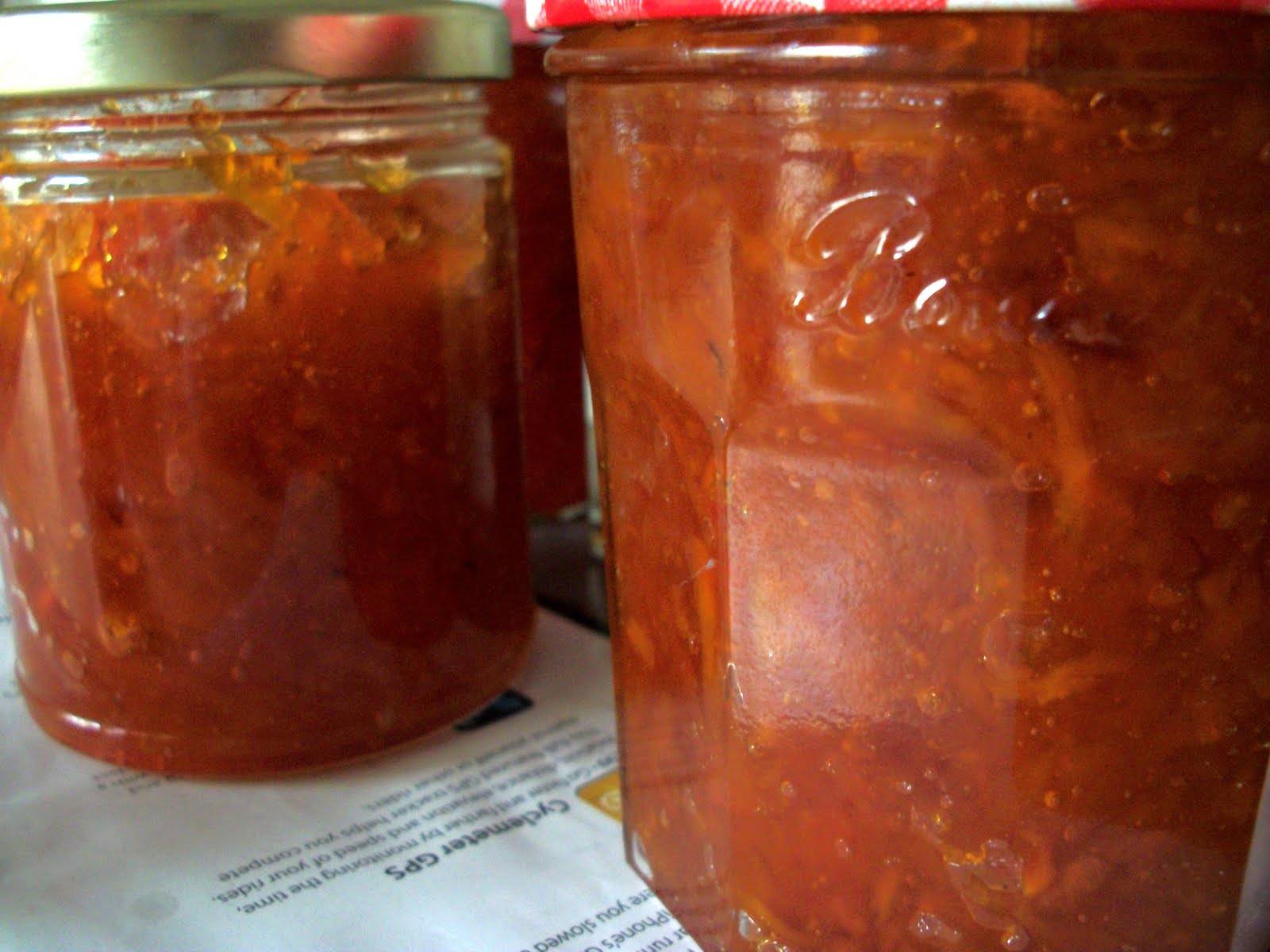
Flicking through the Guardian website last weekend, I came across HFW's recipes for vegetable jams, referencing Mrs. Beeton. I was intrigued by the jam recipes - I made a tomato chilli jam not long ago and really liked it - and the reference coincidence made me think I should really try (at least) one.
Carrot jam
(Makes about three 450g jars).
1kg carrots, peeled and grated
Finely grated rind and strained juice of 2 lemons
Finely grated rind and strained juice of 1 orange
900g granulated sugar
2-3 cinnamon sticks
6 cloves
1 tsp grated nutmeg
Put the carrots, juices, zest and sugar into a preserving pan, and stir. Tie the cinnamon and cloves into a small circle of muslin, tie with kitchen string and place in the middle of the carrots. Leave overnight to macerate.
Pour over about 900ml water, add the nutmeg, warm and stir until any sugar crystals have dissolved. Bring to the boil. Boil until it reaches its setting point, about 30-40 minutes; test to see if it's ready using a chilled saucer.
Carefully fish out the spice bag. Cool for 10 minutes, then pour into warm, sterilised jars and cover with lids or waxed paper discs and cellophane covers while still hot. Store in a cool, dry place and use within one year.
Notes:
It took a long time to reach set point - at least an hour - basically boiled it dry. Perhaps more like crystallised grated carrot. Smelled good while cooking, will have to see how it tastes... Got my eye on the courgette one next.
The taste is good but the texture is off: should have stopped cooking it earlier. Have seen recipes since with addition of bitter almonds rather than the spices used here, I think that would work well (and would contribute to the faux-apricot effect - apparently carrot jam was conceived as a cheapo pretend apricot jam).
Sunday, July 17, 2011
Soy+linseed bread / blackberry jam / summer fruit compote
Another exciting-looking bread recipe from the Guardian. And several bags of blackberries in the freezer since last fall, needing to be used.

Soy and linseed bread
50g rolled oats
50g golden linseed
275ml lukewarm soya milk
1½ tsp easy-blend yeast
325g strong white bread flour
50g wholemeal or rye flour (used wholemeal)
1½ tsp fine salt
Olive or sunflower oil
Put the rolled oats and linseed in a large mixing bowl, stir in 100ml of boiling water and leave for 30 minutes to soften. Add the warm soya milk and yeast, and mix well. Measure out the two flours and the salt, add these to the soya mixture, then stir everything together into a big, soft and sticky dough. Cover and leave for 10 minutes, then knead on a lightly oiled worktop for about 10 seconds. Cover and leave for another 10 minutes. Repeat this knead-and-rest sequence twice more at 10-minute intervals, then leave covered for 30 minutes.
Brush the inside of a deep, 19cm long loaf tin or similar with oil. Roll out the dough into a rectangle about 2cm thick, roll it up tightly and squash it seam-side down into the tin. Cover with a cloth and leave somewhere warmish for about an hour and a half, until doubled in size.
Preheat the oven to 220C (190C fan-assisted)/425F/gas mark 8, slash the top and bake for about 45 minutes. Take the tin out of the oven, remove the loaf from the tin, and leave to cool on a wire rack.
Blackberry jam

3lb blackberries
75ml water
2 tbsp lemon juice
1 cinnamon stick
3lb sugar
Wash and pick over the blackberries (can freeze at this point if desired). Put the fruit in a big pan. Add the water, lemon juice and cinnamon stick and boil until the fruit is softened and reduced (~30min at a good fast bubble). Add the sugar and bring to a rolling boil. Meanwhile, put a saucer in the freezer. Wash jars in hot soapy water, rinse well and put in a low oven to dry. When you think it's nearing set point put a dribble (~1/2 tsp) of hot jam onto the cold saucer and put it back in the freezer for 10min. Take it out and push your finger through the jam puddle. If it wrinkles up the jam has reached set point. When this happens switch off the heat and let the jam stop bubbling / cool for 10 min or so. Then fill the jars. Be careful not to get hot jam on your hands. Put the lids on right away and leave to cool. When cool, wipe off the jars and label.
Notes: The cinnamon was an experiment in making more interesting flavoured jam. Will have to see if can taste it. The lemon juice is not necessary if your berries are reasonably sour, but helps with set so I put some in. It becomes a point of judgement how much lemon juice (if any) to add to achieve a good set, and I don't always get it right. Based on recipes from my AFRC Institute of Food Research preserving book from Grandma.
Summer Fruit Compote
handful of each (all frozen): raspberries, black raspberries, mulberries, blackberries. couple of handfuls blueberries, 150ml tub stewed unsweetened sour cherries. sprinking (~25g?) sugar, 1 cinnamon stick, 1 bay leaf, few drops vanilla essence...
 Put all in a pan and heat until all the fruit is defrosted. Remove from the heat and allow to cool.
Or, Delia's recipe:
3 peaches
6 apricots
6 large plums
8 oz blueberries
6 oz raspberries
2 oz sugar
Slice peaches, apricots and plums and put in an oven dish with the blueberries. Add sugar. Bake uncovered for 25-30min at 180C, until tender. Remove from the oven and stir in the raspberries. Check the sweetness and add more sugar if it needs it.
The bread was good again - the crustiest one yet, and tasty but with relatively simple ingredients. S said it was his favourite for those reasons.
The jam turned out well. The blackberries held up well, and the set was pretty much perfect. Haven't decided yet whether I can taste the cinnamon or not. Made 5 and a bit jars.
Compote was good. Think it is nice to have some bigger, juicier fruit in with the berries though.
Saturday, December 25, 2010
Tomato chilli jam
Made this in the Summer with a glut of tomatoes and chillies from the Haymarket. It was really good - balance of sweet and savoury, hot and sour was all there. Recipe is on the back of an envelope I am using to store stamp edges for jamjar labels in - I just know I am going to lose it or forget it's there...
400g tomatoes
9 red peppers
9 red chillies
6 garlic cloves
thumb sized ginger chunk
700g sugar
200ml cider vinegar / balsamic vinegar / other
I modified this: used only 1 red pepper and more tomatoes. Only had those big long slim red chillies so used a quantity of those that I thought would give a good level of hotness. Used a mixture of balsamic, rice and distilled white vinegar. The balsamic gave it a good, earthy depth of flavour. Overall, the stuff was reminiscent of sweet chilli sauce in a jamlike form, and very more-ish.
1) finely chop tomatoes, peppers, chillies (wearing lab gloves), garlic, ginger
2) put sugar and vinegar in a pan and stir til sugar dissolved. Add other stuff and simmer til reduced / thick and sticky (think ~45-60min)
3) Bring to the boil - cook on high 1 min. Put into sterile jars.
Subscribe to:
Posts (Atom)